

Co-authored by Gerard Pietrykiewicz and Achim Klor
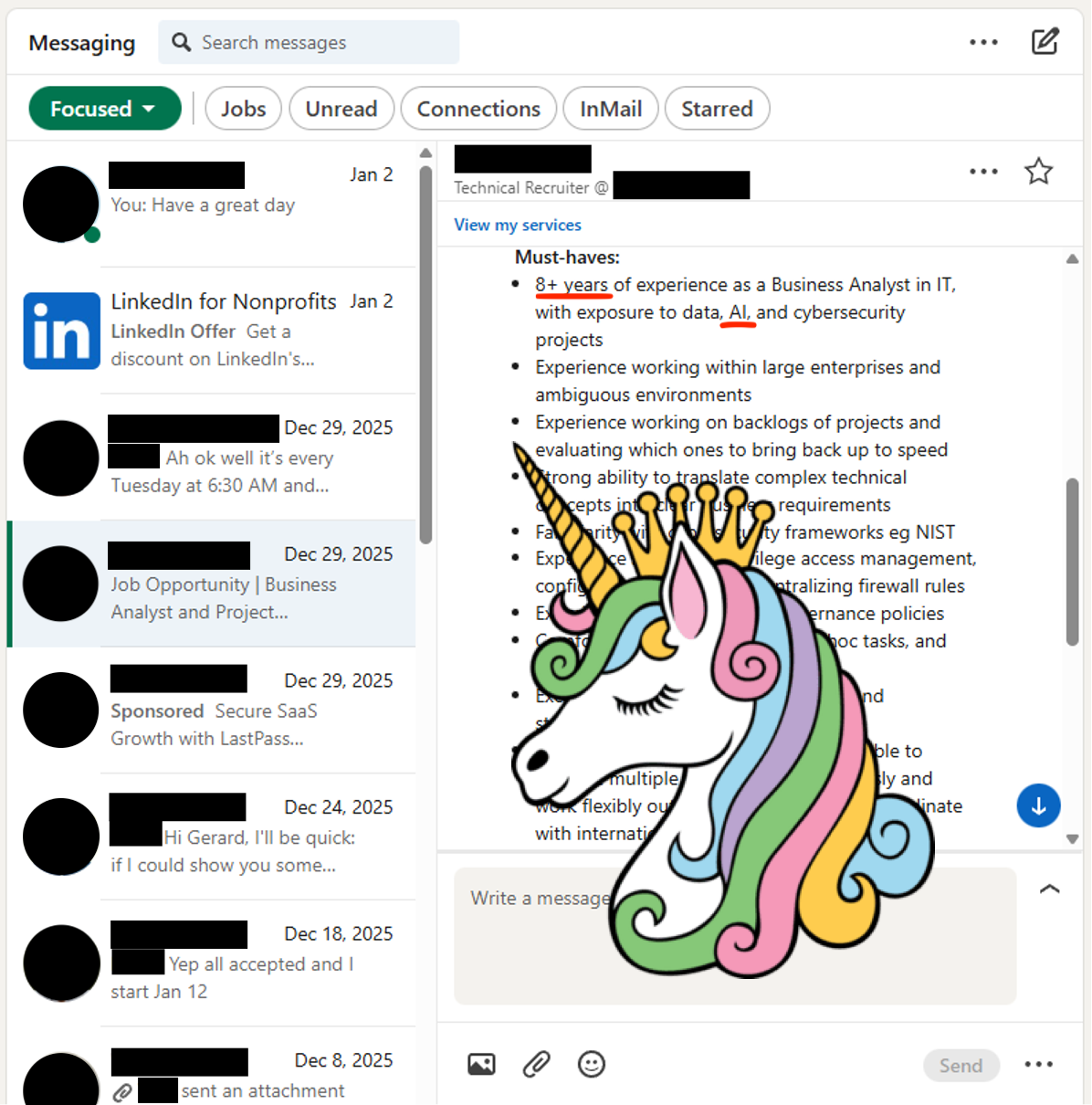
Recently, Gerard received a recruiter pitch on LinkedIn.
It looked like AI wrote it and nobody bothered to fix it.
The role wanted a Business Analyst, Project Manager, AI expert, cybersecurity expert, and governance translator between business and technical teams.
It also wanted 8+ years of AI experience. Really?
This is where a lot of AI adoption goes off the rails.
Not because the tool failed.
Pressed to fill roles, nobody stops to define the actual work. So AI gets handed the job. It produces a bloated, catch-all mess no serious candidate wants to read. It gets blasted out at scale. Candidates fire back AI-generated applications and CVs at scale. HR gets buried in a sea of synthetic sameness.
That’s not a hiring process.
That’s an AI-to-AI death spiral.
HR is just one example. Similar spirals show up across the organization. AI creates the noise, then more AI gets used to clean it up.
Nobody saved time. Nobody hired better. The team ran a faster version of a broken process and called it progress.
SHRM reports that average cost-per-hire and time-to-hire have both risen over the last three years, even as AI use in HR has climbed. More automation did not automatically produce better hiring.
HR teams are not doing this because they are careless. They are buried.
Requisitions pile up. Inboxes fill. Scheduling, screening, follow-ups, compliance documentation. It is a lot of admin for a function that is supposed to be about people and judgment.
So AI looks like relief. Write the JD faster. Screen faster. Reach more candidates faster. SHRM reports that nearly 9 in 10 HR professionals in organizations using AI for recruiting say it saves time or increases efficiency. It is also being used heavily for tasks like writing job descriptions and screening resumes.
The problem is that speed without clarity makes it worse. A badly written job description used to waste a few days. Now it creates a flood of waste.
One generic posting goes out. Hundreds of AI-assisted CVs come back. HR saves time on the front end, then loses it all cleaning up a mess they helped create.
Delegation is not abdication. AI handles the admin. It does not replace judgment.
A marketing hire is not a product hire. A sales hire is not a customer success hire.
A CS leader might need process discipline, de-escalation skill, and commercial awareness. A product marketer might need positioning, customer insight, and message testing. An AE needs discovery skill, objection handling, and the ability to translate business pain into urgency.
These are not the same jobs.
Too many AI-generated JDs make them sound like they were copied from the same template with a few nouns swapped. That’s not speed. And it doesn’t hide the fact that nobody defined the actual work.
Good candidates can tell. They know when a posting was written by someone who understands the role. They also know when it was stitched together from generic prompts and wishful thinking.
AI should help hiring teams get more deliberate. Not more automatic.
Use it for scheduling, interview summaries, scorecard drafts, candidate FAQ replies, debrief notes. That’s the repetitive work that eats recruiter time and produces nothing that requires a human.
Clear that work first. Then use the time to do what AI cannot:
Canada’s Public Service Commission is clear on this point. Hiring managers remain accountable for decisions in the hiring process, and they must validate AI-generated ideas and suggestions to make sure the content is accurate, relevant, and adapted to actual hiring needs.
Before you open the next requisition, answer three questions:
Write the JD after you answer those. Not before.
If your hiring process creates noise faster than your team can think, AI will not help you. It'll just amplify your confusion.
The tool is not the problem.
Delegating your thinking to it is.
If you like this co-authored content, here are some more ways we can help:
Cheers!
Achim is a fractional CMO who helps B2B GTM teams with brand-building and AI adoption. Gerard is a seasoned project manager and executive coach helping teams deliver software that actually works.
This article is AC-A and published on LinkedIn. Join the conversation!
