

Imagine you’re scuba diving.
Cruising along a reef wall, barely noticing the current. Then you try to turn back. You can’t. The current is too strong. You panic and your oxygen starts depleting… fast.
That’s GTM in 2026.
In our last Causal CMO chat, that’s the picture Mark Stouse painted as we talked about what happens when the market current flips.
“Doing more” won’t save you.
Like the scuba diver freaking out, it almost always makes the problem worse.
Mark’s scuba analogy explains what most dashboards ignore.
Think of “the current” as the externalities out of our control. The headwinds, tailwinds, and crosswinds that affect all aspects of the business, especially go-to-market.
When the current helps you, everything feels easy. Your plays work. Your oxygen lasts.
When the current turns, the same plays cost more and convert less. Not because your team forgot how to sell. Because you’re swimming against something bigger than you. Like buyer behavior.
The ugly part: the moment you need more oxygen is the moment the CFO wants to save air.
If we don’t model market conditions as part of GTM performance, we end up blaming our team for the current. We fire the wrong people. We keep the wrong plays. And wonder why the numbers keep sliding.
Mark shared some sobering data from his 5-Part Series on Substack: GTM effectiveness declined 40% between 2018 and 2025.
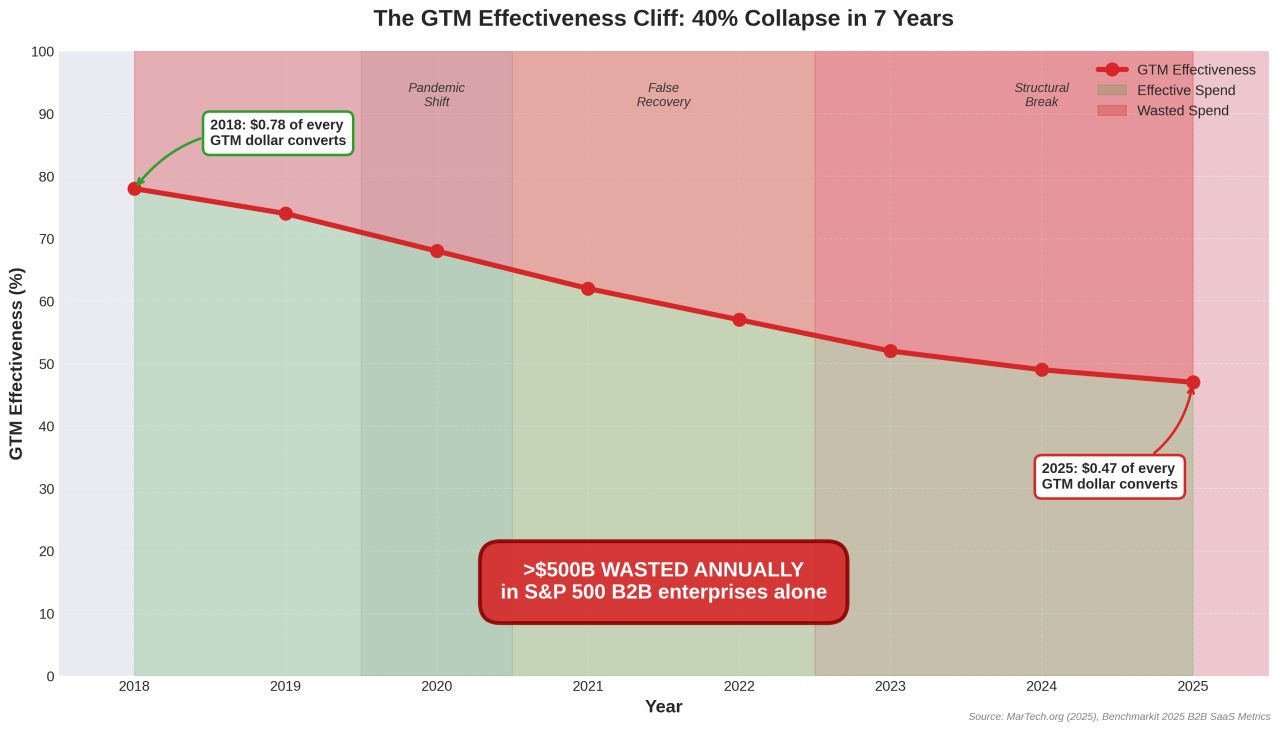
This is not a blip. It’s a systemic break.
Teams kept turning the crank on the same old frameworks while the environment changed underneath them.
Not because they are stupid. Because most GTM systems were built for stable conditions. They never accounted for headwinds, tailwinds, and crosswinds. They just assumed the water would stay calm.
So spend rises. CAC rises. Effectiveness drops.
Mark shared the uncomfortable truth:
70-80% of why anything happens is stuff we don’t control. We like to think we’re masters of the universe, even in some limited domain. But that’s a total fantasy. A fallacy.
GTM hits the wall first because it is the first part of the company that collides with the market. It’s “the canary in the coal mine.”
And when the canary chirps, you do not debate the air. You act. Ignore it and you lose the business.
During our chat, I shared a recent real-world closed-lost analysis where over 60% of lost deals ended in “no decision.” That aligns almost perfectly with The JOLT Effect.
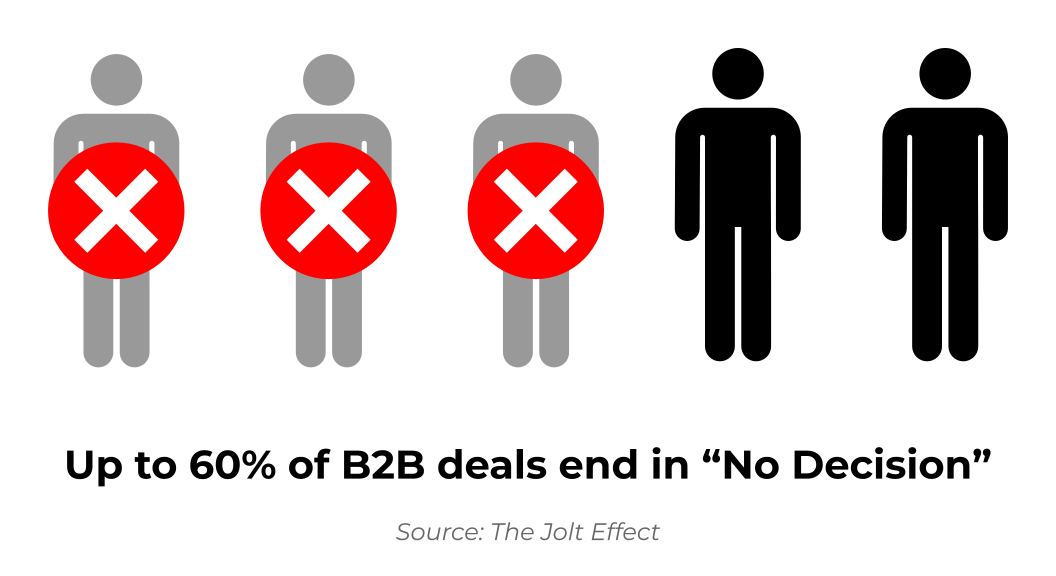
Not lost to a competitor. Not lost on price. Lost to inertia.
And Mark’s research shows as much as 4 out 5 deals are now being lost to no decision.
If your GTM motion is built to beat other vendors, but the real battle is against doing nothing, you’re burning oxygen on the wrong fight.
The data does not lie. It also sucks. You still have to face it before you can change it.
If you are not tracking “no decision” as a first-class outcome, you are guessing about why deals stall. And guessing is expensive when the current turns.
A lot of “process” exists because teams never did the hard work of naming what creates value right now.
Not yesterday. And not tomorrow. Right here. Right now.
Reality changes. Value changes with it.
A lot of reporting is political. Defensive. Built to justify money already spent, not to guide decisions.
That is how process becomes theater.
Lots of activity. Lots of slides. No increase in truth.
What should replace it?
Set expectations up front. Write them down. Then report against them.
Leaders avoid tight expectations because it invites judgment. But in 2026, clear expectations have become the position of highest trust.
Trust has lost the cartilage in the joint. Without it, everything feels bone-on-bone. That is what it feels like right now between CEOs, CFOs, CMOs, and boards when performance slips and nobody agrees on why.
Eventually you hit the “come to Jesus moment” where reality always wins. You stop trying to force the story. You deal with what is.
It’s painful. It’s also freeing. Nobody debates reality.
I asked Mark how he handles teams that resist forecasting because they “don’t have enough data.”
You will never have all the facts. Stop waiting for a condition that will never exist.
His approach is simple:
Bad assumptions do not just mess up tactics. They flow upstream into strategy. You can execute perfectly and still lose because you picked the wrong hill.
This is not rip-and-replace. Causal AI sits on top of what you already have. The hard part is not technical. It is how people think.
Most teams are trained to chase correlation. That habit creates confidence without proof.
The goal is straightforward: track reality now, track it forward, adjust as conditions change.
You might still arrive late. But you can explain why. You can document variance instead of hand-waving it. That changes decision-making. It also changes trust.
Mark shared a story about his physicist mentor who told him to “use what you know to navigate what you don’t know.”
It reminded me of Neil deGrasse Tyson:

Mark turned that into an operating mindset.
You have been behaving like a librarian, organizing what you already know. Be an adventurer. Care more about what you don’t know than what you do know.
In other words, stop defending the map. Start updating it.
If your GTM effectiveness is sliding and the default response is “more leads” or “more output” or “new tools,” pause.
“More” won’t save a bad model.
If your model of reality is based on yesterday (or what you hope it to be), your KPIs won’t guide you. They’ll distract you. They’ll keep you busy while you drift.
A few gut checks:
Most likely, your stack isn’t what’s broken.
Your model of reality probably is.
Missed the session? Watch it here
If you like this content, here are some more ways I can help:
Cheers!
This article is AC-A and published on LinkedIn. Join the conversation!
