

By Gerard Pietrykiewicz and Achim Klor
Achim is a fractional CMO who helps B2B GTM teams with brand-building and AI adoption. Gerard is a seasoned project manager and executive coach helping teams deliver software that actually works.
The CEO asks: “What’s our AI strategy?”
Most teams respond the same way. They spin up a working group, collect vendor lists, and crank out a 30-page deck with a three-year roadmap.
It looks impressive.
But it does nothing for Monday morning.
Your AI strategy should change decisions, habits, and outcomes inside the week. Otherwise it’s just theatre.
A strategy is not “we will use AI.”
That’s like saying “we will use spreadsheets.” It’s meaningless.
A real strategy starts with a business obstacle that hurts. Then it makes a clear choice about what to do next.
For example, in a recent boardroom meeting, we heard the following adoption target:
“20% of our workforce will use AI at least 10 times a day by the end of 2026.”
The point isn’t who said it. The point is what it measures: habits.
Not pilots. Not slide decks. Not “exploration.”
Using roadmaps for AI will answer the wrong question.
They answer: “What could we do with AI?”
Leaders need the opposite: “As an organization, how can we be more effective at solving our problems?”
As Michael Porter wrote, strategy is choice. It forces trade-offs. It forces you to decide what you won’t do.
Leaders create success frameworks. If you’re successful, the company will be too. These are the basics of OKRs.
AI roadmaps avoid that work. They hide weak choices behind more swimlanes.
Most people scan. They read the top, skim the left edge, and move on.
Nielsen Norman Group documented this behavior with eye-tracking research and the F-shaped scanning pattern.
So if your “strategy” needs a 30-minute read and a 60-minute meeting to decode it, it will die.
A one-page strategy survives because it can be:
Toyota has used the A3 approach for decades: put the problem, analysis, actions, and plan on a single sheet.
Lean Enterprise Institute describes an A3 as getting the problem, analysis, corrective actions, and action plan onto one page.
Same idea here.
One page forces clear thinking and clear communication.
Why? Because real strategy has three parts: diagnosis, guiding policy, measurable target.
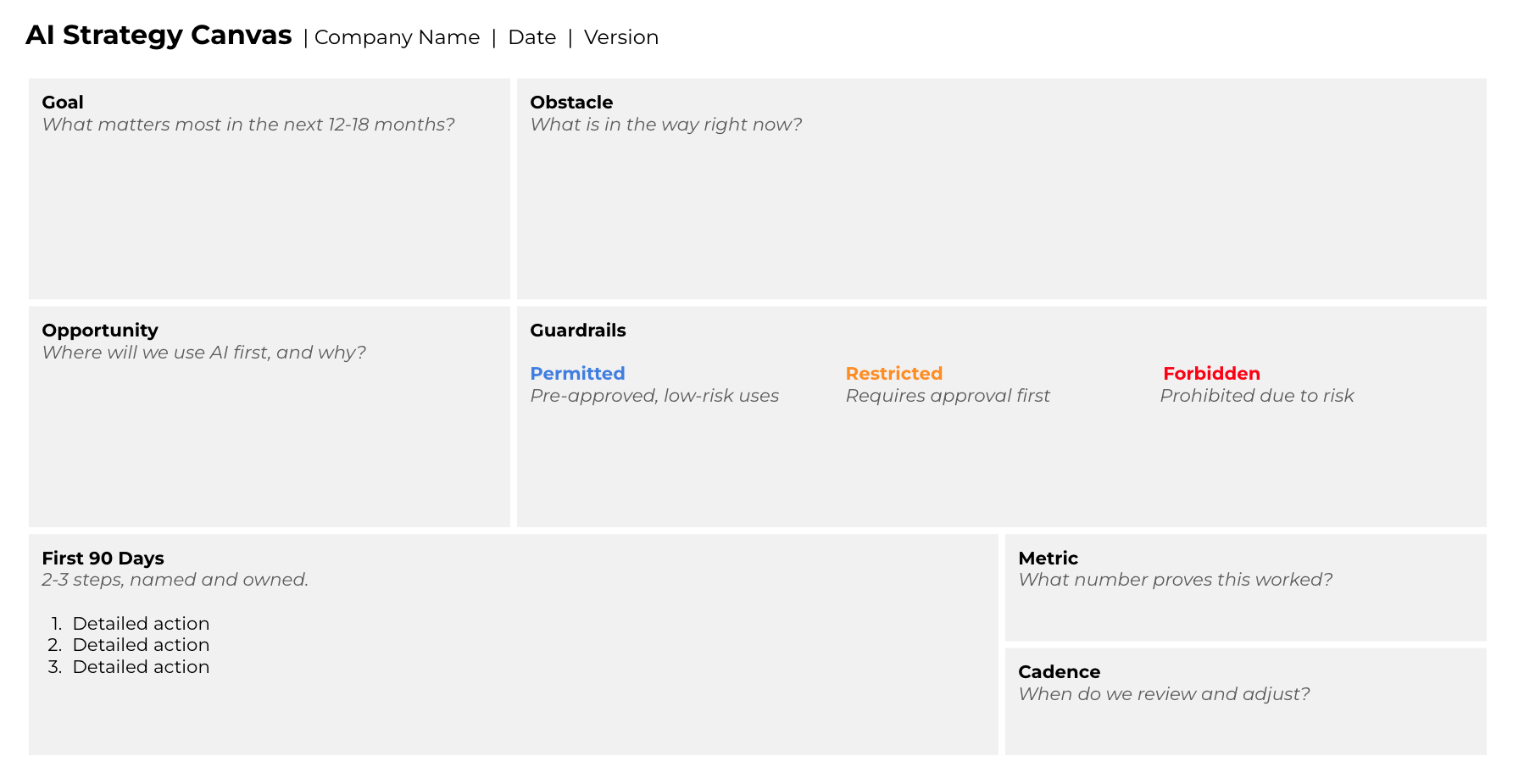
Make a copy of this One-Page AI Strategy Canvas (shown above).
Complete the first page (use the second page example if you’re not sure).
Do one draft only. Try not to tinker or wordsmith.
Then send it to three people who will actually challenge you: one exec, one operator, one skeptic.
Book a 30-minute call.
Your only job in that call is to tighten the choices.
Avoid committees and drawn-out timelines. They defeat the purpose.
Too often, companies get stuck here:
Simple policies beat long policies. The rule of three helps people remember every time.
Try this three-bucket guardrail approach:
Keeping things in buckets of three creates clarity.
Clarity turns “I’m not sure if I’m allowed” into “I know what I can do right now.”
Many teams already use AI at least occasionally, even when leadership thinks “we’re still figuring it out.”
Gallup reported daily AI use at work at 10% in Q3 2025 and 12% in Q4 2025, with “frequent use” (a few times a week) at 26% in Q4.
Strategy can’t live in a deck. It has to show up in habits.
Stop writing AI roadmaps nobody will read.
Start with a one-page strategy people can use.
In the next installment, Gerard and I will show you how to turn the One-Page AI Strategy Canvas into an OKR and keep it alive with a simple 12-month review cadence so it doesn’t become “write it once, forget it.”
If this was useful, forward it to one peer who’s drowning in “AI strategy” swimlanes.
If you like this co-authored content, here are some more ways we can help:
Cheers!
This article is AC-A and published on LinkedIn. Join the conversation!
