AI OKR Cadence: Run AI for 12 Months and Prove the Uplift

By Gerard Pietrykiewicz and Achim Klor

Achim is a fractional CMO who helps B2B GTM teams with brand-building and AI adoption. Gerard is a seasoned project manager and executive coach helping teams deliver software that actually works.

If your AI plan does not start with a real business problem, it’s a hobby.

Write one page that says: 

  • I have a problem. 
  • I have an obstacle. 
  • AI can help me outsource.

Then turn it into an OKR, so it survives meetings, churn, and Q2 priorities.

Key takeaways

  • Start with the obstacle, not the tool.
  • AI helps people solve problems. It does not own the decision.
  • Pick one use case. Measure it like you mean it.
  • Guardrails speed adoption because people stop guessing what’s allowed.
  • If it’s not on a calendar, it won’t stick.

Sound familiar?

Someone says, “We need an AI strategy.”

Two weeks later you have:

  • a tool short-list
  • a slide deck full of swimlanes
  • ten opinions
  • zero change in how work gets done

That’s a common pattern.

This article is a follow-up to One-Page AI Strategy Template: Replace Roadmaps With Clarity, where we argued that your AI strategy should fit on one page.

This article shows you how to write it, then turn it into an OKR, then run it for 12 months without it turning into another forgotten “playbook” in your drawer.

The One-Page AI Strategy

Open a doc and answer the following four questions.

1) Diagnosis: where are we now?

A strategy has to earn its keep.

Prompt:

  • What is our single most important goal for the next 12–18 months?
  • What obstacle is blocking this goal right now?
  • Where can AI take work from 0 to 80% in minutes so our people can finish the last 20% and ship?

Example:

  • Goal: Improve retention.
  • Obstacle: Support is stuck answering repetitive tickets all day. Response time slips. Burnout rises.
  • How AI helps: Deflect the repetitive work so humans can handle complex cases.

If your diagnosis starts with “We want to use AI,” you’re already off course. AI is not a replacement plan. It’s an outsourcing plan for the first draft.

2) Guiding policy: how will we use AI?

This section stops chaos.

You need two things:

  • Primary focus: Make it one use case. One sentence. For example: “Our primary AI focus is to reduce support load by resolving common inquiries with approved AI tools, so agents can spend time on complex cases.” This is your spine.
  • Guardrails: They are the lanes that let people move faster because they stop second-guessing. Stay in your lane. Not sure? See the table below.

Category What it means Examples
Permitted Low-risk, pre-approved Summaries of internal docs, first drafts, meeting notes, unit test scaffolding, outlines
Restricted Needs review Anything using customer data, automating client-facing messages, connecting tools to production systems
Forbidden Too risky PII in public tools, sensitive financial data in prompts, unapproved tools connected to company systems

AI helps you solve the problem. It does not solve it for you. It does not own the decision.

If you want a practical risk anchor, OWASP’s LLM Top 10 maps well to what breaks in real deployments (prompt injection, insecure integrations, unsafe output handling).

And if leadership wants a governance reference, NIST AI RMF and the GenAI profile give you a credible backbone without turning this into a policy manual.

3) Target: What does success look like (and did AI matter)?

Pick one metric that proves the policy worked.

Target:

  • Business KR: the outcome we want.
  • AI Lift KR: the delta we only get because of AI.
  • No-cheating KR: the metric that catches gaming or quality collapse.

Example: 

  • Business KR: “Resolve 50% of incoming support tickets by end of Q3 with 90% CSAT.”
  • AI Lift KR: “AI increases ticket resolution rate by +15 points versus the same process without AI (holdout test).”

Now add no-cheating metrics:

  • Reopen rate
  • Escalation rate
  • Time-to-resolution for escalations

If those get worse, your “wins” are fake.

4) Coherent actions: what are the first steps?

List the next 2–3 actions for the next 90 days.

Example:

  1. Pick one approved pilot tool and one measurement method.
  2. Categorize the top 20 ticket types and define the escalation path.
  3. Publish the Allowed/Restricted/Not allowed policy and train managers on it.

If your first step is “create a committee,” you’re writing a plan to feel safe, not to get results.

Turn the one-page strategy into an OKR

This is where it becomes operational.

Google’s OKR guidance keeps it simple: 

  • Objectives set direction.
  • Key Results stay measurable and easy to grade.

Objective

Your Primary focus becomes the Objective. Human. Clear. Directional. For example: “Use AI to reduce support load so our agents can solve customers’ hardest problems.”

Key Results

Your Target becomes the KR. Numeric. Time-bound. Auditable. For example: “Resolve 50% of incoming support tickets via approved AI by end of Q3, with 90% CSAT.”

Now each team can set supporting KRs that fit their world, but everyone works against the same top-level definition of success.

12-Month AI Cadence

Here’s a 12-month timeline with five swimlanes. This cadence keeps your AI outsourcing plan alive after kickoff.
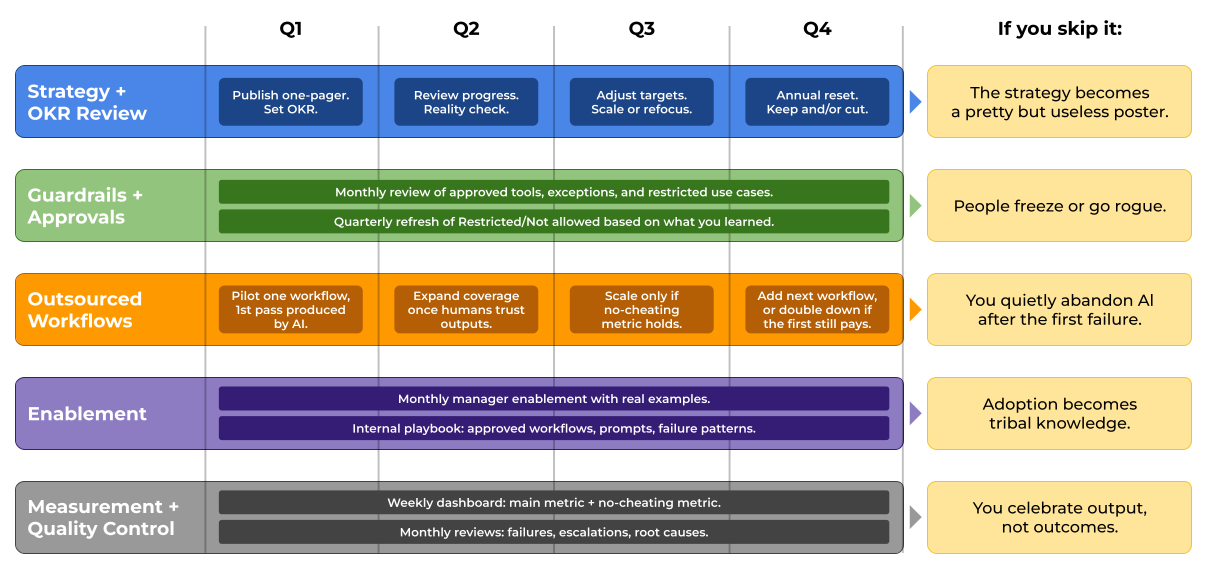
12-month AI OKR cadence diagram with swimlanes for OKR review, guardrails, outsourced workflows, enablement, and measurement.

Final thoughts

AI adoption fails because of a lack of planning and discipline.

People can’t connect it to a problem they actually own.

As we already covered in the previous article, one page fixes that.

An OKR keeps it alive.

A calendar makes it stick.

AI does not replace accountability. It exposes whether you have any.

If you like this co-authored content, here are some more ways we can help:

Cheers!

This article is AC-A and published on LinkedIn. Join the conversation!