


By Gerard Pietrykiewicz and Achim Klor
Achim is a fractional CMO who helps B2B GTM teams with brand-building and AI adoption. Gerard is a seasoned project manager and executive coach helping teams deliver software that actually works.
The White House recently posted a TikTok with AI-edited media that put fake words in Brady Tkachuk’s mouth. Tkachuk called out “the fake news” publicly.
And although the video disclosed it contained AI-generated media, the damage was done. It stayed up and reached over 11 million views as of this publication.
That’s what happens when you prioritize output over judgment.
The label doesn’t protect you. The audience still holds someone accountable. Someone has to do damage control. In the case of the White House TikTok, that someone is Brady Tkachuk.
The point of this example is that B2B GTM teams are also doing a version of this. Here’s why.
Before AI, GTM teams were already stretched. Headcount flat. Targets up. Leadership asking for more content, more campaigns, more touchpoints, more MQLs.
Along comes AI, which looks like the answer. Faster copy. Faster decks. Faster everything.
Nobody stopped to ask: more of what, exactly? For whom? Why would anyone care?
Skip those questions and you don’t get growth. You get more crap.
And chaos.
Content goes out without critical thinking, fact-checking, or proofreading. The assumption is that someone else reviewed it. Often nobody did.
Teams publish without knowing who it’s for or why anyone would care.
Remember the Queensland Symphony Orchestra AI-generated Facebook ad?

That was in 2024 when AI was nowhere near as good as it is today. And it was still approved!
Even their own musicians took exception. According to Slipped Disc, when musicians raised concerns with the marketing director, they were told to “stay in their lane.” Boooo!
The Guardian covered the broader fallout, including the arts union calling it unprofessional and disrespectful. The post was eventually removed.
For an organization whose entire value is human performance and craft, the audience saw the contradiction immediately.
When the focus stays on tools instead of the broken model underneath, this is what you get.
If the thinking is weak, publishing faster doesn’t help. You just reach the wrong audience (or no audience) with the wrong message faster.
AI doesn’t fix a bad execution. It amplifies it.
Effectiveness first. Then efficiency. Flip that order and you don’t get more done. You do the wrong things faster, with more anxiety, and less to show for it.
The vibecoding article we wrote in December is worth repeating here. The demo tape captures an idea so the band can react and interact. Then you go to the studio with real instruments and real people and lay down the actual track.
The demo was never the album. It was a faster way to ideate.
AI is like the demo tape phase. Use it to make you better at your job. Research faster, stress-test messaging, get that first draft done so your team has something to go on. In other words, “demo” your creative ideas.
That’s the right way to use the tool.
Use AI to help you do a better job, not do the job for you.
The final output still needs a human who understands the customer and can tell the difference between content that connects and content that just takes up space.
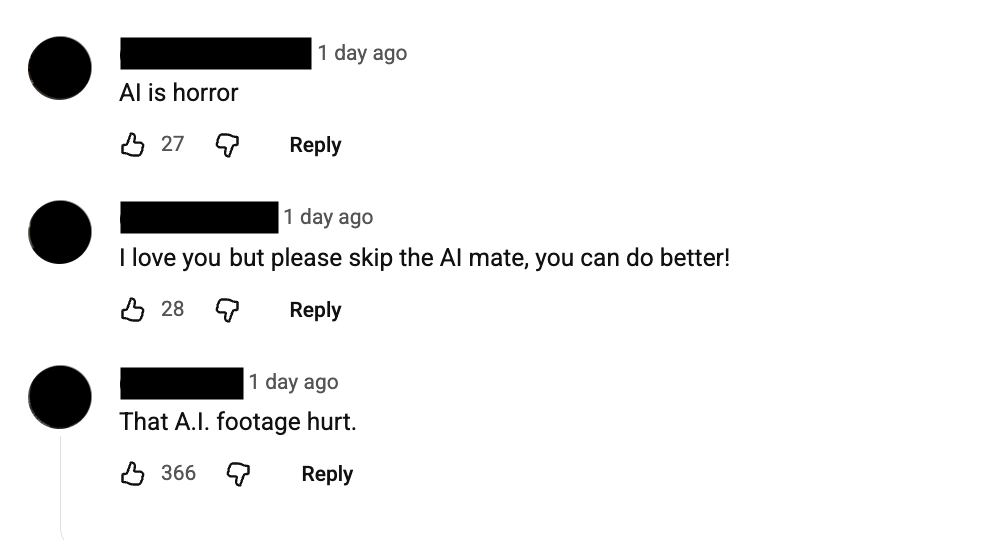
If you “ship the demo”, buyers can tell, as shown above from a few comments of a popular YouTube channel.
A 2026 survey of 277 B2B marketing leaders in the UK and Ireland found that 71% of companies use AI primarily for content creation, and 56% see its main value in tactical execution. Most teams aren’t using AI to think better. They’re using it to ship faster in whatever direction they were already going.
If that direction is wrong (or outdated), you’re just headed in the wrong direction faster.
The tools didn’t create this. The pressure to work old models did. And pressure is a leadership variable.
The tool is not the problem. The thinking (or lack thereof) behind the tool is.
If your team can’t tell you who a piece of content is for, what decision it supports, and what proof backs the claims, that’s not an AI problem.
Fewer campaigns with a real point of view beat more campaigns with none. In this case, less is more.
Before anything goes out, ask your team to show you two things:
If they can show you both, you’re good.
If all they can show you is the prompt, that’s your “come to Jesus” conversation.
And that conversation isn’t about the tool.
If you like this co-authored content, here are some more ways we can help:
Cheers!
This article is AC-A and published on LinkedIn. Join the conversation!
