

By Gerard Pietrykiewicz and Achim Klor
Achim is a fractional CMO who helps B2B GTM teams with brand-building and AI adoption. Gerard is a seasoned project manager and executive coach helping teams deliver software that actually works.
Vibe-coding gets hyped as a way to “build an app in minutes.” That’s not the useful part. The useful part is this: it lets you create disposable prototypes fast enough that teams can stop guessing and start reacting. It’s a clarity tool, not a shipping tool.
Many teams (engineering, product, GTM) still work like this:
Write a doc. Explain it in a meeting. Someone turns it into wireframes or copy. Meet again. Then build something so everyone can finally see what you meant.
That’s a relay race with too many handoffs.
Vibe-coding collapses it into one run. Idea to clickable prototype to feedback in the same sitting.
Fewer handoffs. Fewer miscommunications. Fewer sprints wasted building the wrong thing because everyone had a different mental picture.
Poor requirements are among the top reasons software projects fail, and misalignment between what's needed and what's built drives rework and delays. We've written before about why AI adoption stalls. Vibe-coding addresses that gap early, when changes are still cheap.
Back in the 90s, I used a Fostex 4-track to record demo songs on cassette tapes (see pic below). You’d lay down drums and bass first, then guitars, keys, vocals, etc. If you needed more than four tracks, you’d mix some down to free up space. Every time you did that, you’d lose a bit of quality.
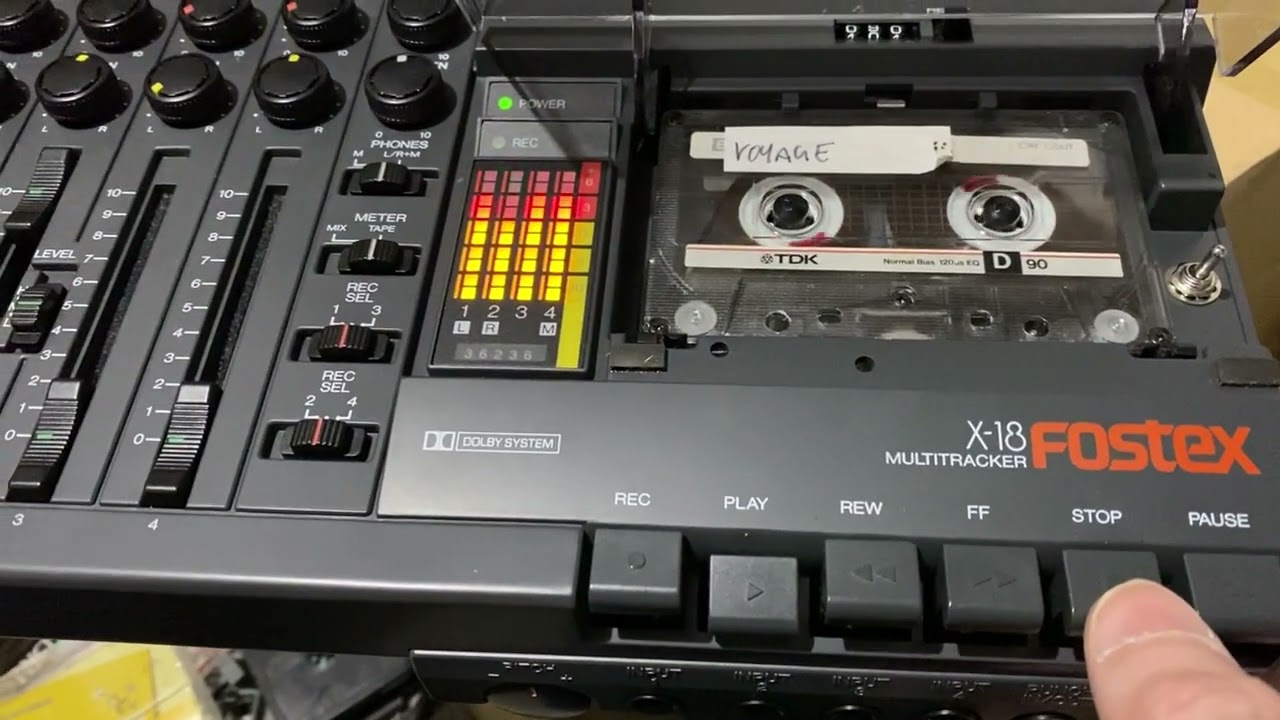
It was limited and rough. But it got the song down so the band could practice their parts and make decisions.
You weren’t making the album. You were capturing enough structure so everyone could hear the same thing and figure out what worked and what didn’t.
Then you’d take that into a real studio and record it properly. That part was expensive and laborious, so you didn’t want to walk in there still arguing about the chorus.
The demo tape forced clarity before the expensive work started.
Vibe-coding (even GenAI) plays the same role for product work. The prototype is the demo, not the album.
And here’s what people miss: efficiency is a byproduct of effectiveness. If you build the wrong thing faster, you just waste time at a higher speed. 8x0 still equals 0.
Gerard recently built a DRIP calculator prototype.
He started with a short Product Design Doc (roles, basic flow, key screens). He used Manus to shape prompts for Bolt, pasted them in, and generated a working front-end prototype.
PDD to clickable prototype: 28 minutes.
Not production code. Not secure. Not deployable. But it had screens, navigation, inputs, and a flow you could walk through with a dev team.
That changes the conversation.
Instead of debating abstract requirements, you click through like a user would and the real questions surface:
You see where the flow breaks. You see what’s confusing. You see what you can cut without losing the core experience.
Gerard's 28-minute prototype helped the team clarify requirements before dev work began, avoiding the usual back-and-forth about what to build.
That’s the “demo tape effect”. You expose weak parts while changes are still cheap.
When Pro Tools came out, home recording got better but it was still too expensive. Hardware, interfaces, software required a budget most musicians didn’t have.
Apple’s GarageBand changed that (bottom right, one of my recent “demo songs”). Suddenly anyone could lay down ideas without dishing out loads of cash. It’s not Logic or Final Cut, but it’s good enough.
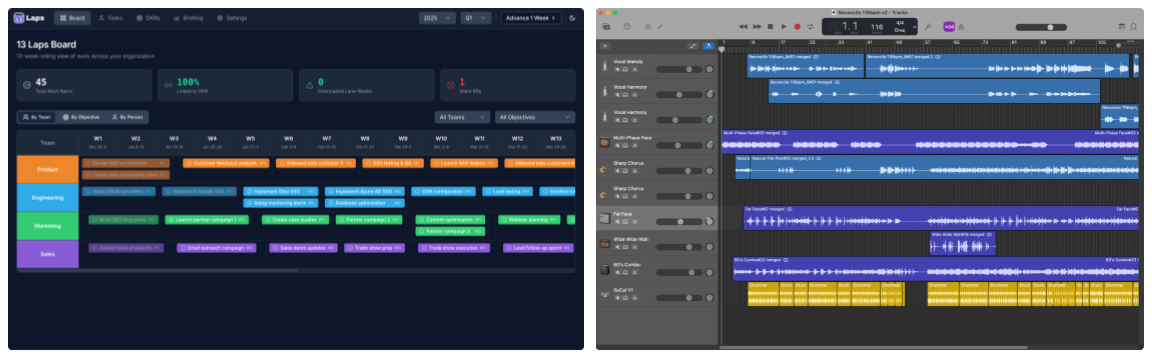
AI feels similar to me (top left, one of my prototype “demos” in Loveable). Tools like Claude, ChatGPT, Lovable, and Cursor let me build prototypes much quicker than before. Not production-quality (or well-written). Not secure. But good enough to test an idea and get feedback before committing real resources.
That shift from “you need professionals” to “you can try this yourself” changes who gets to prototype and how fast ideas move.
Vibe-coding is a fast way to get concrete.
It’s not a replacement for engineering. The prototype is disposable, like a demo in GarageBand. Useful, rough, temporary.
Your real product still needs code standards, reviews, testing, security, proper architecture.
Vibe-coding just helps you walk into that work with fewer assumptions and tighter decisions.
Think of it as the new whiteboarding. It shows everyone the same thing before you start building the real thing.
Looking for more ways to make AI adoption practical? See how we use AI to draft slide decks in minutes.
Again, it’s not perfect, but progress trumps perfection.
Pick one feature you’re planning to build next month. Use a vibe-coding tool to generate a clickable prototype this week. Spend 30 minutes walking your team through it.
Track what happens: How many requirements get clarified? How many assumptions get challenged? How many “oh, I thought you meant...” moments do you avoid?
That’s the value. Not the prototype itself. The alignment it creates.
Once you align on what to build, let your team build the actual product (the right product) without wasting a sprint on guesswork.
If you like this co-authored content, here are some more ways we can help:
Cheers!
This article is AC-A and published on LinkedIn. Join the conversation!
