

Your GTM playbook worked... two years ago.
That’s the uncomfortable (and inconvenient) truth that stood out after my recent Causal CMO chat with Mark Stouse, the CEO at Proof Causal Advisory.
We didn’t debate whether old methods are broken. That’s already been settled. We got into what it actually takes to fix the problem: a shared model of reality that CEOs, CFOs, and GTM teams can all work from.
Right now, most companies do not have that. They have siloed dashboards, attribution debates, and quarterly budget battles. The CEO wants confidence. The CFO wants proof. The GTM team wants room to do the work.
Nobody is singing from the same song sheet.
And that, my friends, is the Causal Bridge the entire organization must build together.
Here’s the recap.
Mark didn’t mince words about the truth of this common mindset:
“You can be right two years ago or a year ago and be dead wrong today. And that’s just circumstances outside of your control.”
Most GTM banter is insular and plays the blame game. Wrong strategy. Wrong hires. Wrong execution. But Mark’s research points to a different culprit: Externalities.
They are the headwinds, tailwinds, and crosswinds in the market that make up 70-80% of what drives outcomes. Things no one on your team controls.
He estimates that in the last 10-15 years, over 95% of GTM ineffectiveness traces back to teams failing to factor in those external forces. We keep running the same plays into a market that has already moved way past us.
“You’ve got your framework, and you’re turning the crank over and over again. But you’re doing it into the teeth of a hurricane.”
If that sounds familiar, the problem is not your team. It is the model you are using to read the market.
Marketing budgets have flatlined. Gartner’s 2025 CMO spend survey put them at 7.7% of company revenue, flat year over year, while scrutiny from Finance keeps rising. That pressure has a specific shape.
Finance is no longer treating GTM spend as opex. It’s now considered a loan of shareholder capital. Revenue acquisition, profit acquisition, cash flow acquisition. And loans require payback.
When CAC spikes while deal volume falls and velocity slows, the payback period stretches until the math stops working.
“A CFO once said to me that if go-to-market was its own business, it would be bankrupt.”
The three outcomes Finance is actually watching:
Each maps to revenue, margin, and cash flow. If your reporting cannot connect activity to those three things, you are speaking a language the CFO cannot act on.
Right now, faster time to close is the single cash flow move most likely to get a CFO off your back. That is how tight the pressure is.
Here is the part that makes the CFO’s skepticism harder to argue with.
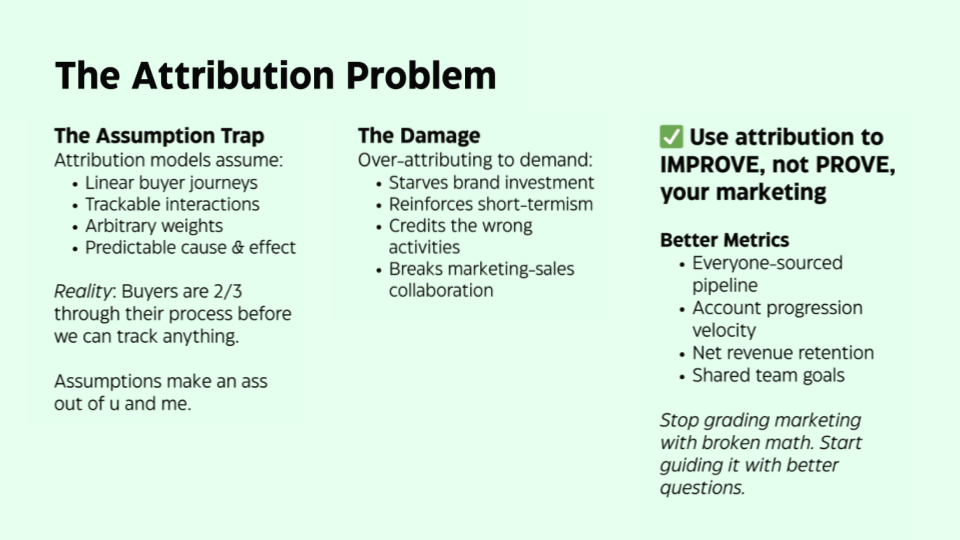
The attribution tools GTM teams have relied on for 10-15 years were not measuring reality. They were measuring assumptions.
Every model, first-touch, last-touch, multi-touch, was built on arbitrary weights and a fiction that B2B buying is a linear, deterministic, and trackable sequence of cause and effect. It is not. It has never been.
Multi-touch attribution in particular looked at desired reality, not actual reality. Change the weightings, change the results. That is not measurement. That is a fairytale generator.
“MTA didn’t look at reality. It looked at your desired reality. It looked at your beliefs.”
What makes this harder to dismiss: Jon Miller, co-founder of Marketo and one of the architects of modern demand generation, admitted “Attribution is BS”.
His argument: buyers are already two-thirds through their decision process before they engage with vendors. The interactions that actually shaped the deal, anonymous content consumption, word of mouth, prior brand exposure, happened long before any tracking pixel fired. The “credit” arbitrarily went to whatever campaign was running when someone finally filled out a form.
Miller’s conclusion: teams have been grading marketing with broken math.
The result: brand investment starved, short-termism rewarded, sales-marketing alignment broken, and stalled growth. That damage is real and it accumulated over more than a decade.
This is why Finance lost trust in GTM reporting. It is not just that the numbers were sometimes wrong. It is that the system was designed in a way that let teams produce whatever numbers they needed to cover their asses. CFOs figured that out. That is a significant part of why the loan framing now lands the way it does.
True story: A CFO wanted to eliminate marketing entirely. Just to see what happened.
Well, there’s actually a model for that:
“We can show it with marketing. We can show the date that you kill all funding for marketing. We can show how long it takes for the results to degrade your performance, and then it’ll show the cliff that you fall off of. It ranges from nine to twelve months. It’s as sure as death and taxes.”
Time lag is what fools people. Cut marketing, ride the wave from past investment, coast for say, 9-12 months, then watch sales nosedive. By the time it registers, you are nine months behind on rebuilding and killed all your momentum.
We covered this pattern during our Illusion of Control chat.
Brand, for example, is not a soft metric. It is a multiplier of sales productivity that requires more time than we are willing to give it. And because time lag makes the impact of building brand reputation invisible in the short term, impatient CEOs and CFOs don’t invest in it.
When leaders see a causal model for the first time, the first readout shows waste. That almost always makes everyone at the table squeamish. But there is good news:
“The real aha moment is when it dawns on them that going forward, they have just de-risked their spend and their decisions dramatically.”
That is the shift from CYA and defending past spend to making better calls about future spend. From fighting over revenue credit to understanding that sales gets the credit for driving revenue and marketing multiplies what sales can do (marketing does NOT create revenue!).
With correlation-based tools, we change the weightings and we change the results. We can manufacture any narrative. With Causal AI, we cannot. The model does not care about our assumptions. It reflects reality.
“There’s great alignment between Causal AI and reality. In fact, I say a lot that causation equals reality.”
That is exactly why Causal AI builds trust with Finance, and exactly why most GTM leaders have been slow to adopt it.
We already talked about how to do a skunkworks GTM project. Mark brought it up again because it works, and because it sidesteps the politics that kill most internal change efforts before they start.
If you’re not ready to make this a company-wide initiative, start by picking one part of the business, run the model quietly for nine months, and make decisions based on what it shows.
“People around you will not understand that you’ve done something, but they will feel it. You’ll start getting comments in the hallway: there’s a new energy coming out of marketing.”
When results are visible, tell the story. Your peers already believe it. You are just giving them the explanation for what they felt.
Good teams are getting judged like bad teams right now. Not because they stopped performing. Because the market moved and the model did not.
The CEO, CFO, and GTM team are not failing to communicate because they are stupid or in different departments. They are working from different models of reality.
Until that changes, every quarter continues to be the same fight. More pressure. More reporting. Same broken loop.
The market moved. The model did not.
That is the problem.
And now you know what the fix looks like.
Missed the session? Watch it here. Mark’s full 5-part research is on his Substack.
If you like this content, here are some more ways I can help:
Cheers!
This article is AC-A and published on LinkedIn. Join the conversation!
